
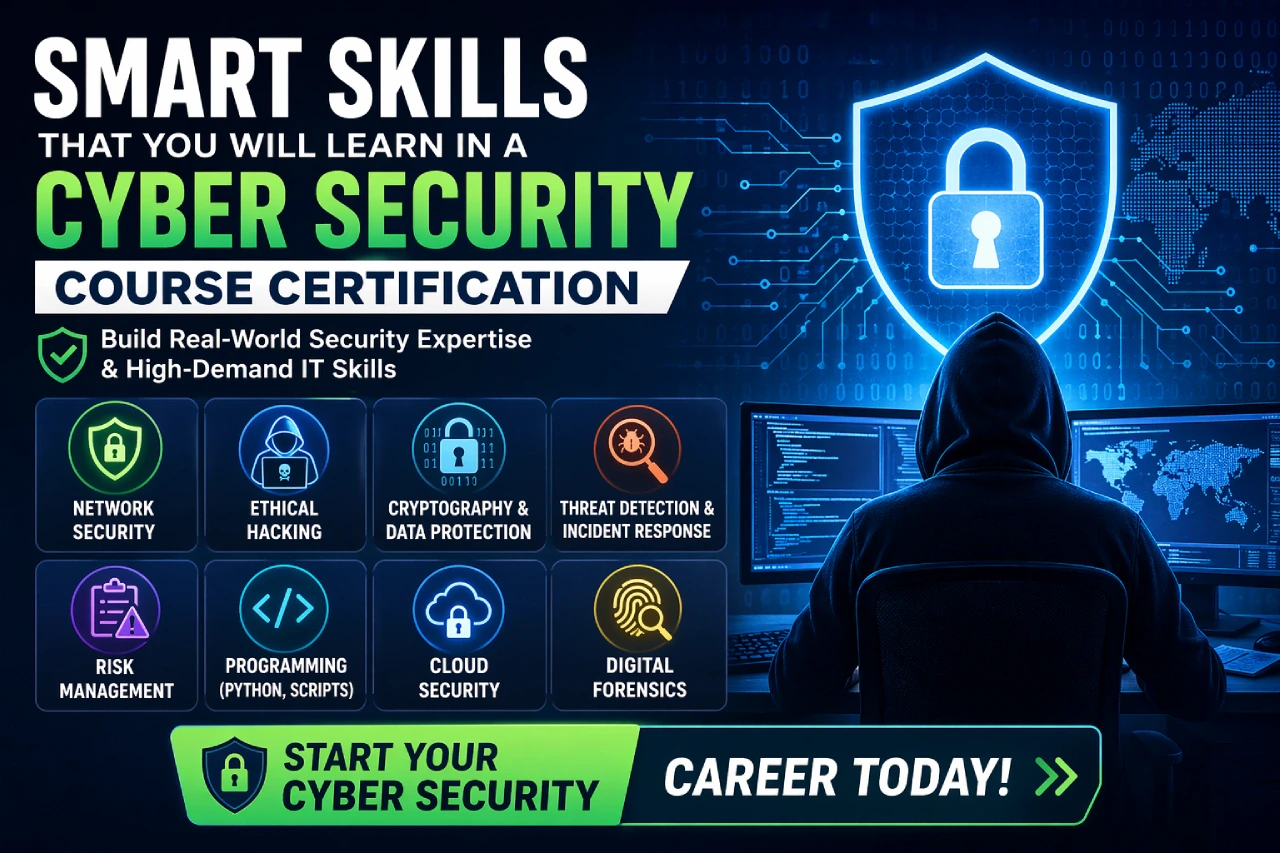
Smart Skills That You Will Learn in a Cyber Security Course Certification
Cybersecurity is the practice of securing systems, data, and networks from digital attacks, damage, or theft. It uses processes, controls, and technologies to ensure the confidentiality, availability, and integrity of information. A Cyber Security course in Delhi is significant for combating rising cybercrime, meeting global demand, and protecting sensitive data, and it offers a high-paying market for skilled professionals.
In this comprehensive blog, we will cover the key skills that every individual will learn in this course. Apart from this, we will also discuss the fundamental career options in this field, among other topics.
Significance of Cyber Security Course in Delhi
Let’s go through the importance of cyber security course in Delhi that you will know if you are planning to build a career in this field:
- Cybersecurity experts are in short supply globally, offering job security and excellent remuneration packages.
- Training at the Cyber Security institute in Delhi includes instruction on protecting against attacks such as phishing, ransomware, and data leaks that may cause corporate bankruptcy.
- Cybersecurity Training includes learning how to protect sensitive infrastructure and data from hacker access.
- This profession adapts to new security threats, such as artificial intelligence scams. The courses ensure that learners are knowledgeable about the latest methods for securing data.
- Training covers topics including network security, ethical hacking, risk analysis, and incident response.
Check Out the Skills That You Will Learn in the Cyber Security Course
In this section, let’s explore the essential skills every individual should learn in a Cyber Security course in Delhi before embarking on a bright career path.
1. Advanced Threat Detection and Incident Response
One of the most vital skills to learn is how to detect, mitigate, and analyze cyber threats in real-time. You will learn to identify Indicators of Compromise (IOCs) and use security tools to monitor network traffic for suspicious behavior. It includes mastering Security Information and Event Management (SIEM) systems, which aggregate data to help you respond to breaches rapidly, minimizing downtime and damage.
2. Cloud Security Fundamentals
With organizations shifting to the cloud, learning how to secure AWS, hybrid environments, and Azure is essential in a Cyber Security course in Delhi. You will learn to configure cloud security groups, implement secure access controls, and manage data privacy within a shared responsibility model. Likewise, this skill involves protecting virtual machines, serverless architectures, and containers against unauthorized access.
3. Ethical Hacking and Vulnerability Assessment
To safeguard a system, you must think like a hacker. Ethical hacking (penetration testing) is a “get-in-their-heads” skill in which you are professionally trained to proactively identify weaknesses in networks, infrastructure, and applications before negative performers do. Thus, it involves using tools such as Nmap, Kali Linux, and Wireshark to scan for vulnerabilities such as SQL injection and cross-site scripting (XSS), and, lastly, recommending remediation strategies.
4. Network Security Controls and Architecture
You will master the basics of how all essential data moves across a network and how to safeguard it. It includes understanding TCP/IP, configuring firewalls, setting up VPNs, and implementing network segmentation to prevent sideways activity by hackers. When you opt for a Cyber Security course in Noida or in Delhi NCR, you will learn to analyze network traffic for anomalies that suggest a violation or unauthorized access.
5. Risk Management and Governance
Cybersecurity is not just about a technical issue. It reflects a huge business risk if avoided. This skill involves specifying, assessing, and mitigating potential risks to an organization’s assets. You will learn to align security initiatives with business goals by implementing a framework, such as ISO 27001 or NIST. Additionally, it includes a better understanding of compliance needs and regulatory guidelines, such as HIPAA and GDPR.
6. Scripting and Automation (Python/PowerShell)
While not everyone needs to be a full-time software developer, learning to code is a major differentiator. PowerShell and Python are typically taught to automate repetitive tasks, such as log analysis or system scanning, allowing you to concentrate on advanced-level threat hunting rather than manually sorting all the data. Moreover, automation accelerates incident response, enabling you to detect threats more quickly.
7. Digital Forensics and Malware Analysis
At the Cyber Security Institute in Delhi, you will discover that digital forensics and malware analysis are two critical components that one must learn before venturing out into the world of cybersecurity. In addition to this, after an attack has been launched, this is where your ability to determine the “how” and “what” lies. Digital forensics will train you on how to collect and analyze data, which includes evidence taken from servers, mobile phones, or even personal computers, for any potential legal use in the future.
8. Identity and Access Management (IAM)
In the Cyber Security course in Delhi, you will learn that identity is the new security perimeter. You will learn to implement strong, end-to-end encrypted authentication mechanisms, such as single sign-on (SSO) and Multi-Factor Authentication (MFA). Nevertheless, this skill concentrates on ensuring that only the right people have access to the right resources, lowering the risk of compromised credentials, which is the leading cause of data violations.
9. Operating System Security (Windows and Linux)
A solid, fundamental skill is understanding how to protect Windows and Linux environments at the OS level. It includes system administration, managing user privileges, hardening servers, configuring logging, and patching vulnerabilities. Consequently, you will learn how operating systems handle memory and file systems to detect abnormal activity.
Why Do Cyber Security Skills Matter in the Real World?
It is critical to have cybersecurity skills in the practical world, as they can help protect one’s privacy, secure essential infrastructures, and safeguard their financial interests from fast-emerging cyber attacks. They reduce the chances of any identity theft and violation of data by individuals, while corporations can avoid enormous financial losses, business interruptions, and loss of customer confidence in a digitally oriented world. Hence, there are several key reasons why it is important to learn the essential skills taught in the Cyber Security course in Delhi:
- Businesses have to hire security personnel to protect their networks and data from any breach. Security could prevent any attacks that cost hundreds of millions in damages, along with the damage to the reputation of losing customers’ trust.
- Careers in cybersecurity are some of the highest-paying and recession-proof jobs out there. The field offers several career opportunities, such as threat intelligence analyst, security consultant, and security response specialist, among others, and almost all industries will need security experts in the future.
- Cybersecurity expertise would ensure that public utilities, medical devices, and government systems run seamlessly.
- Having a grasp on the basics of cybersecurity, including creating a robust password, enabling two-factor authentication, and recognizing phishing scams, would ensure that hackers cannot exploit your weaknesses and steal your identity and funds.
- By virtue of cybersecurity experts, companies could implement emerging technologies like artificial intelligence and cloud computing without compromising their security.
Career Opportunities After Obtaining Cyber Security Course Certification
The following table illustrates career prospects after completing a Cyber Security course in Delhi, along with their job roles, responsibilities, critical skills needed, and salaries in the Indian labor market:
| Job Role | Key Responsibilities | Skills Required | Average Salary (India) |
|---|---|---|---|
| Cyber Security Analyst | Monitor systems, detect threats, respond to attacks | Networking, SIEM tools, risk analysis | ₹5 – 8 LPA |
| SOC Analyst (Security Operations Center) | Monitor alerts, investigate incidents, and report threats | Log analysis, incident response, and tools like Splunk | ₹4 – 9 LPA |
| Ethical Hacker / Penetration Tester | Find vulnerabilities by testing systems | Ethical hacking, Kali Linux, CEH | ₹4 – 10+ LPA |
| Network Security Engineer | Secure networks, firewalls, VPNs | Networking, firewalls, IDS/IPS | ₹5 – 10 LPA |
| Cyber Security Engineer | Design secure systems, implement protections | Programming, encryption, security tools | ₹5 – 12 LPA |
| Incident Responder | Handle cyber attacks in real-time | Forensics, threat detection, response planning | ₹6 – 14 LPA |
| Cloud Security Engineer | Secure cloud infrastructure (AWS, Azure) | Cloud security, DevSecOps | ₹10 – 25+ LPA |
| Security Consultant | Advise companies on security strategies | Risk management, compliance, auditing | ₹12 – 30+ LPA |
| Security Architect | Design overall security systems | Advanced security design, architecture | ₹17 – 30+ LPA |
| Chief Information Security Officer (CISO) | Lead the entire security strategy of the organization | Leadership, governance, risk management | ₹30 – 90+ LPA |
Wrapping It Up!
A Cyber Security course in Delhi offers a blend of managerial, technical, and business education that prepares learners to address current and future cybersecurity challenges effectively. As technology continues to advance, the demand for skilled, security-aware professionals will only increase. Hence, this course makes you future-ready for a world where every business needs skilled professionals.
Whether you are a beginner or have considerable IT experience, Cybersecurity offers a strong and rewarding career path. In this comprehensive field, growth potential, job security, and salary levels are all exceptionally high. Thus, if you wish to take your career growth to a brighter, more promising level, acquiring cybersecurity skills is a smart investment that ensures long-term success. Enroll with Rexton IT Solutions and become a cybersecurity professional with a valuable degree and remarkable knowledge. Connect with our support team on WhatsApp at (+91) 1800 412 7615 or by emailing us at [email protected].
Frequently Asked Questions
Ans: During the course, you will be acquainted with several software programs, including:
- Nmap (Network Scanner)
- Wireshark (Packet Sniffer)
- Kali Linux (Suite of Hacking Tools)
- Metasploit (Pen Testing Framework)
- Splunk (Log Analyzer/SIEM)
Ans: Of course! In-depth programming skills are not required to study Cyber Security. The course begins with fundamental networking and allied subjects, which make the learning process easier even if you are from a non-IT background.
Ans: Cyber Security offers various career options, such as:
- Cyber Security Analyst
- Ethical Hacker/Pen Tester
- Cloud Security Engineer
- SOC Analyst
- Security Consultant, among other professions.
Ans: Apart from acquiring numerous crucial skills during the course, here are a few examples:
- Threat Detection/Response
- Network Security/Firewalls
- Risk Management/Compliance
- Scripting (Python/PowerShell)
- Digital Forensics/Malware Analysis