
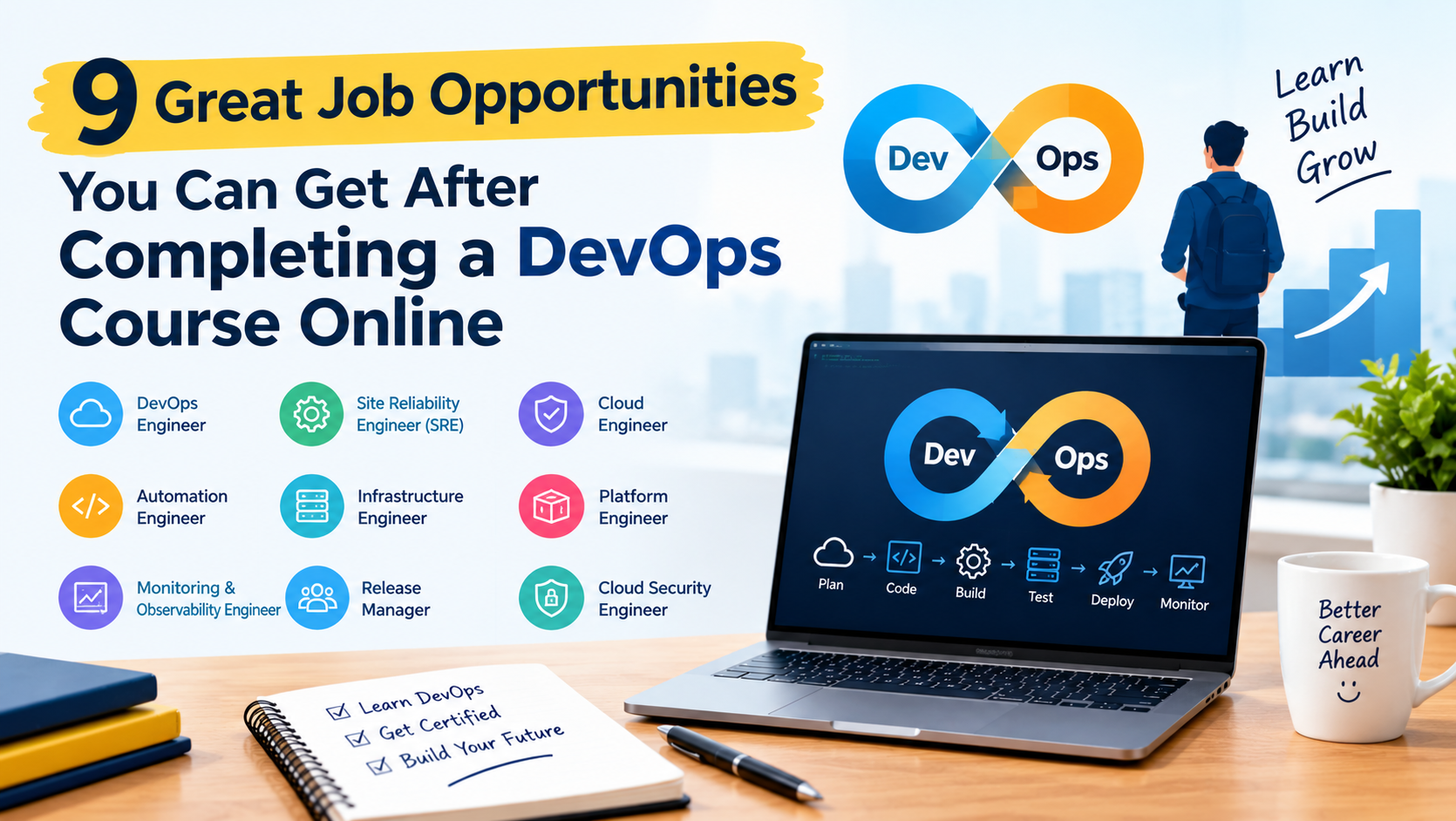
9 Great Job Opportunities You Can Get After Completing a DevOps Course Online
The demand for faster software delivery, reliable applications, and automated IT operations has made DevOps an integrated part of modern software development. Companies across different industries are looking for professionals who can bridge the gap between development and operations, streamline workflows, and help teams to deliver high-quality software efficiently. This growing need has opened doors to several exciting career opportunities for aspiring IT professionals. Furthermore, enrolling in a DevOps course online can help you build the technical knowledge and practical skills for these fruitful career paths. From automating software deployments to managing cloud infrastructure and monitoring application performance, DevOps professionals contribute to nearly every stage of the software delivery lifecycle.
Whether you are a working IT professional, recent graduate, or someone planning a career transition, learning DevOps after enrolling in the best DevOps course online can expand your professional options. In this comprehensive blog post, we will discuss some lucrative job opportunities you can get after completing this course. Let’s get started!
Check Out the Following Job Opportunities You Get After Completing a DevOps Course Online
The following career paths show how DevOps course online platform can enable you to explore various specialties, from infrastructure to automation and from cloud computing to security.
1. DevOps Engineer
DevOps Engineers bridge software development and IT Operations to increase collaboration and automate certain processes to speed up software delivery. This career path is for those who like scripting and problem-solving as part of their job. A DevOps course online program will give you an introduction to the tools and workflows used by DevOps Engineers.
Key Responsibilities:
- Automation of build, testing, and deployment processes of software.
- CI/CD pipeline creation and maintenance.
- Working with software development and IT operations teams.
- Monitoring the performance of the applications and troubleshooting deployment issues.
Required Skills:
- Linux and scripting tools such as Python or Bash.
- Git and CI/CD tools such as Jenkins.
- Basics of Docker and Kubernetes.
- Cloud Platforms.
2. Cloud Engineer
Cloud Engineers design and maintain systems on platforms like AWS, Azure, and Google Cloud. They help organizations to establish scalable infrastructure, manage cloud resources, and ensure system uptime. Enrolling in a DevOps course online will offer a good start for people who want to learn about cloud-based infrastructure.
Key Responsibilities:
- Provisioning of cloud resources.
- Configuring networks, storage, and virtual machines.
- Monitoring cloud performance and resources.
- Making infrastructure more reliable and cost-effective.
Required Skills:
- Basic knowledge of AWS, Azure, or Google Cloud.
- Networking and Linux skills.
- Using Infrastructure as Code tools like Terraform.
3. Site Reliability Engineer (SRE)
Site Reliability Engineers use software engineering approaches to address infrastructural and operational issues. The main aim of an SRE is to enhance the reliability, availability, and performance of applications as well as reduce the amount of manual operations performed. DevOps professionals can progress in this career path by gaining skills in observability, automation, incident handling, and distributed systems.
Key Responsibilities:
- System availability and application monitoring.
- Automation of operations and incident handling.
- Troubleshooting outages and performance issues.
- Service level indicator and objective development.
Required Skills:
- Coding/scripting languages such as Python, Go, or Bash.
- Monitoring solutions like Prometheus and Grafana.
- Cloud computing and distributed systems.
- Incident handling.
4. Build and Release Engineer
A Build and Release Engineer is responsible for managing the compilation, packaging, testing, and delivery of the software to be used consistently throughout the development, testing, and production environments. They facilitate the release process and assist teams in avoiding errors in delivering software. An DevOps course online can prove helpful for individuals willing to follow this career track.
Key Responsibilities:
- Maintaining build and release pipelines.
- Managing versions and releases of the software.
- Deployment processes.
- Identification and resolution of build issues.
Required Skills:
- Version control tools like Git.
- Jenkins, GitLab CI/CD, or similar tools.
- Maven or Gradle.
- Deployment and testing.
5. Cloud DevOps Engineer
A Cloud DevOps Engineer is a person who merges the knowledge of cloud computing with automation and continuous delivery techniques. These engineers work with businesses to ensure that applications are deployed to cloud infrastructure, while keeping in mind scalability, security, and consistency. A learner may find it quite easy to transition into this position, especially after completing a DevOps course online.
Key Responsibilities:
- Automate cloud infrastructure.
- Create and manage cloud-based CI/CD pipelines.
- Deploy and scale up containerized applications.
- Ensure efficient monitoring, security, and reliability of cloud infrastructure.
Required Skills:
- Experience with AWS, Azure, or Google Cloud infrastructure services.
- Docker and Kubernetes.
- Terraform and other Infrastructure as Code tools.
- CI/CD and cloud networking automation.
6. Automation Engineer
The Automation Engineer is responsible for creating scripts and workflows that eliminate repetitive manual operations, bring in more consistency, and improve overall efficiency. In a DevOps team, they can help automate testing, configuration, deployments, and maintenance. Learners interested in programming and optimizing processes can build upon their DevOps knowledge to become Automation Engineers.
Key Responsibilities:
- Recognize the processes that can be automated.
- Create scripts for deployment and maintenance.
- Automate testing and configuration processes.
- Debug and optimize workflows.
Required Skills:
- Python, Bash, or PowerShell.
- Git and software development basics.
- Ansible or other configuration management tools.
- CI/CD pipelines and testing.
7. Infrastructure Engineer
The infrastructure engineer deals with the underlying infrastructure of applications, such as servers, network systems, storage, and operating systems. The application of DevOps concepts will make it easier for these engineers to transition from managing the infrastructure manually to automatically managing it. A DevOps course online is recommended for those interested in learning more about infrastructure engineering.
Key Responsibilities:
- Manage servers, network systems, and other resources.
- Provision infrastructure for applications and services.
- Perform configuration and maintenance of infrastructure.
- Ensure system availability and disaster recovery.
Required Skills:
- Linux and Windows Server administration.
- Networking and virtualization.
- Terraform and configuration management.
8. DevSecOps Engineer
DevSecOps Engineers are experts who implement secure practices within the software development and release process. Unlike traditional software developers, they are involved in identifying vulnerabilities within the software delivery cycle as opposed to just at its end. A DevOps course online program will lay the groundwork required to become a DevSecOps Engineer, with subsequent knowledge of application security and compliance.
Key Responsibilities:
- Embedding security checks within the CI/CD pipeline.
- Performing scanning for code, dependencies, and images.
- Ensuring secure configurations of infrastructure.
- Aiding in vulnerability investigation and remediation.
Required Skills:
- Knowledge of CI/CD tools and scripting.
- Cloud security and cloud identity management.
- Container security and vulnerability scanning.
9. Kubernetes Engineer
The Kubernetes Engineer deals with container orchestration tools to ensure application deployment, scaling, and management. The job helps development and operations teams keep the consistency of the application environment and make systems more resilient. Having laid a foundation using a DevOps course online, learners can choose the path of specialization in Kubernetes using practical knowledge of clusters, network configuration, storage, and workload management.
Key Responsibilities:
- Manage Kubernetes clusters.
- Configure application workloads and services.
- Identify and resolve container and cluster problems.
- Optimize scalability, availability, and resource utilization.
Skills Required:
- Docker and Kubernetes.
- Linux administration and networking.
- Helm and container deployment.
Why is Rexton Solutions’ DevOps Certification Worth It?
Choosing the DevOps course will help you apply your DevOps concepts with more confidence while solving your problems. At Rexton IT Solutions, our DevOps course online could be an option for those students who want guidance to learn the current trends in development and operations. Before opting for the program, one must analyze its curriculum, the experience of the trainer, practical tasks, and certifications provided, whether they suit your needs. A good learning process will assist you in relating theoretical concepts to practical ones, developing your problem-solving skills, and creating a portfolio showing your technical skills to future employers.
The following features will be a part of a good learning experience:
- Learning process for beginners and professionals.
- Practical experience with popular DevOps tools.
- Concepts about CI/CD pipelines and automation.
- Cloud computing concepts.
- Infrastructure management practical experience.
- Assistance in projects and portfolio development.
- Preparation for technical interviews and certifications.
It’s Time To Wrap Things Up!
We hope this blog has provided you with all the precise details about the significant opportunities that you can get after completing a DevOps course online. However, if you feel you have a strong technical background and would like to pursue a career in DevOps, you may wish to consider a program at Rexton IT Solutions. Whether you want to ask questions before signing up about the syllabus, the kind of project work, and other information on the training format and support for students, our professionals are here to guide you every step of the way. So, what are you waiting for? Pick a program that suits your level and goals, and start practicing what you have learned. Connect with our team today to get precise details on our DevOps courses.
Frequently Asked Questions
Some of the positions that you can work as include DevOps engineer, cloud engineer, site reliability engineer, automation engineer, build and release engineer, infrastructure engineer, DevSecOps engineer, cloud DevOps engineer, and Kubernetes engineer.
Yes. As a beginner, one can start by learning programming, Linux, networking, Git, and cloud before moving to automation, CI/CD, containers, and deployment projects.
While having some level of programming skills is important, being a skilled programmer is not required at first. You should start by learning scripting and then move to automating IT tasks.
It will depend on the course program, your previous skills, and how much time you allocate to practice.
Some of the skills that you need to develop include:
● Linux admin and Git.
● Python or Bash scripting.
● CI/CD tools and automation.
● Docker and Kubernetes.
● Cloud and IaC.