
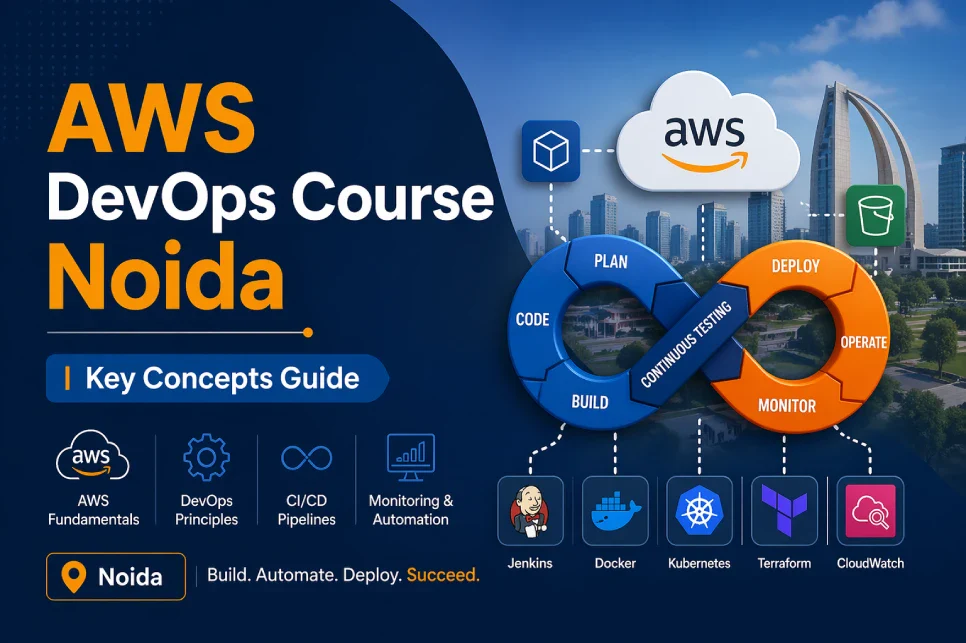
Fundamental Concepts to Focus On While Learning AWS DevOps
In the growing digital world, cloud computing and automation have gained prominence, especially for developing scalable systems. For this reason, DevOps, along with cloud computing, has gained prominence as one of the most in-demand skills in the IT industry. If you wish to build a solid foundation, taking an AWS DevOps course can teach you some essentials.
However, just knowing how to use the tools is not sufficient. You also need to know some of the basic concepts. Irrespective of your experience level, there are certain concepts you need to focus on that give shape to your entire learning experience. Moreover, in this complete blog post, we will discuss all the essential concepts that every new learner should be aware of while pursuing their AWS DevOps learning journey.
Must-Know Concepts While Learning as AWS DevOps Beginners
Opt for the AWS DevOps course and learn some vital concepts to learn that every individual should know if they are planning to build a career in AWS DevOps:
1. Cloud Platforms (AWS, Azure, GCP)
When it comes to cloud expertise, it is the base of modern DevOps. Furthermore, engineers who have completed their AWS DevOps course must know how to build, deploy, and scale solutions across Amazon Web Services (AWS), Google Cloud Platform, and Microsoft Azure. Each platform offers vital services for computing, serverless functions, networking, and storage that underpin CI/CD systems. Multi-cloud metrics and cost-optimization methods are becoming imperative as companies seek resilience against lock-in and service outages.
2. Containers and Kubernetes
Containerization has redesigned how applications are designed and shipped. Docker handles packaging, while Kubernetes manages application scaling and enhances the uptime in distributed environments. Thus, it becomes important to understand concepts such as Ingress Controller, Pods, and ReplicaSets to use microservices effectively. In 2026, container security and edge computing will become essential, with master tools like OPA Gatekeeper and Kubernetes Event-driven Autoscaling (KEDA) to achieve compliance.
3. Infrastructure as Code (IaC)
Manual infrastructure management is outdated. That is why learning IaC from the best AWS training in Noida allows DevOps engineers to maintain the framework editioning, auditing, and reproducibility. Tools such as Ansible, Pulumi, and Terraform enable automated provisioning and configuration across diverse environments. With GitOps workflows, changes to working frameworks can be securely tracked and reviewed, aligning perfectly with cloud governance and security standards.
4. Continuous Integration and Continuous Deployment (CI/CD)
CI/CD pipelines built the nervous system of DevOps. Some popular tools for automated builds, deployments, and testing include Jenkins, GitLab CI/CD, Argo Workflows, and GitHub Actions. Make sure you learn how to tune the pipeline, manage rollbacks, and implement blue-green deployment to guarantee seamless deployment processes. By 2026, integration of AI into the CI/CD pipeline is expected to expedite use detection and predictive rollbacks.
5. Monitoring, Observability, and AIOps
Traditional alerting alone is not enough to learn the key concepts in the AWS DevOps course. Modern observability demands high-fidelity monitoring with tools such as Grafana, the Elastic Stack (ELK), Prometheus, and Middleware. The next step is adapting AIOps, AI-driven observability that detects anomalies and expects disruption before they happen. Moreover, these essential platforms enable teams to concentrate on resolutions rather than reacting to repetitive incidents.
6. Security Integration (DevSecOps)
Security integration is also known as DevSecOps. Therefore, it integrates continuous vulnerability checks, runtime protection, and compliance auditing into every stage of development. Ensure you know Trivy, Aqua, and Snyk Security for container scanning, and use policy-as-code mechanisms, such as Open Policy Agent (OPA), to automate access control. However, the shift-left strategy will most likely dominate 2026, embedding cybersecurity intelligence early in pipelines.
7. Automation and Scripting
Automation still forms the bedrock of DevOps. In terms of understanding the most important concepts through the top AWS training institute in Noida, make sure that you pick up skills to automate via scripting in Bash, Go, and Python, and write infrastructure scripts and API integrations. Scripting can cut down on overhead costs tremendously by automating incident responses, compliance reporting, and backup cycle reporting. Combine your scripting knowledge with an event-driven architecture using technologies such as Azure Functions and AWS Lambda.
8. GitOps and Configuration Management
GitOps takes a new approach towards applying infrastructure changes, using Git as the source of truth. Technologies like FluxCD and ArgoCD will take care of updating live clusters with changes from Git repos. This means that Helm charts, Ansible, and Kustomize will become necessary to know about.
9. Soft Skills and Collaboration
DevOps is as much about culture as it is about technology. Strong communication, documentation, and empathy skills are key to bridging silos between development, cybersecurity, and operations teams when learning AWS DevOps. In addition, use tools such as Slack, Notion, and Jira to promote transparent collaboration, handle incidents efficiently, and ensure cross-functional alignment on production goals. Ensure that high-quality code reaches production.
Opt for the Best AWS Training Institute in Noida to Build Your DevOps Career!
When it comes to AWS DevOps, candidates should understand the most fundamental principles: collaboration and communication. Furthermore, without a proper knowledge of the needs of a DevOps job role, you will most likely end up juggling a lot of information. Nevertheless, we hope this blog has provided you with all the precise must-know concepts while learning DevOps from the best institute that delivers the AWS DevOps course. Mastering AWS and DevOps training opens every door to exciting job opportunities in cloud computing and automation.
So, if you are searching for the best institute in Delhi, look no further than Rexton IT Solutions. Our team of experienced and skilled professionals ensures one-on-one, clear doubt sessions. So, what are you waiting for? Enroll with Rexton IT Solutions with AWS training in Noida today and gain hands-on expertise with real-world projects.
Frequently Asked Questions
Ans: The candidate needs to develop a solid understanding of the basics of cloud computing, particularly AWS services. Moreover, after becoming trained with these, you would find it relatively easy to understand concepts such as CI/CD, Docker, and Git.
Ans: It is profitable to have a basic coding experience before enrolling in the AWS DevOps course. It is not necessary to be a master coder, but it is better to have some skills in this area. Thus, here are vital skills that you must know:
- It facilitates automation through Bash scripting
- It is needed to integrate APIs using the Python language
- It helps create YAML or JSON configuration files
- It is required to debug scripts
Ans: Here, we have mentioned the significance of Containers and Kubernetes in DevOps:
- It offers Docker, which encapsulates applications
- Kubernetes automates its management and scaling
- It improves high availability
- Microservices architecture can be easily used
Ans: The most obvious benefit of implementing a CI/CD pipeline is increased efficiency during the development phase. When any change is introduced to the code, the pipeline automatically builds it, tests it, and applies the changes. For companies, this means significant savings in time and cost.
Ans: DevSecOps means incorporating security aspects within all stages of the development process. Nonetheless, this approach is gaining momentum due to the following reasons:
- Early identification of vulnerabilities
- Automated security checks
- Ease of maintaining compliance
- Reduced risk of data breach