
F5 BIG IP LTM Certification Training – Job-Oriented Course with Placements
F5 BIG-IP LTM Certification Training at Rexton IT Solutions offers a job-oriented course that will enable you to become proficient in the fundamental concepts of load balancing and application delivery. Through this training, you will learn F5 BIG-IP Local Traffic Manager (LTM) with practical examples so that you can apply your knowledge in managing enterprise networks confidently. Trained faculty members of Rexton IT Solutions will guide you through this training, from basic concepts of pools, virtual servers, and nodes to advanced traffic management concepts. Nonetheless, this training course is designed for professionals seeking to advance their careers in networking and application delivery.
Enroll Now

Book A Demo Class
Why is This F5 BIG IP LTM Course Different?
At Rexton IT Solutions, this F5 BIG-IP LTM course stands out for its combination of in-depth theoretical knowledge and hands-on, real-world labs and whiteboard sessions. Furthermore, this course covers complex topics, including iRules, traffic management, and SSL offloading, ensuring candidates are prepared for both certification exams and industry-level roles. Furthermore, here are some key benefits that every candidate will get after enrolling with Rexton IT Solutions
- Job Opportunities: Regular placement drives ensure exciting job opportunities, and you can begin your journey with confidence.
- Learn Your Way: You can opt for online or offline learning and learn at your own pace, as per your convenience.
- Focused Mentorship: Personalized doubt clearance sessions with industry experts will further strengthen your concepts and enhance your confidence.
- Complete Job Preparation: You will be thoroughly prepared for the recruitment process through mock interviews, resume development, and expert career guidance.
- Unlimited Access for Life: You will get lifetime access to course materials, video lectures, study materials, and interview questions even after completing the course.
- Hands-On Excellence: You will get hands-on experience with the latest cloud and cybersecurity tools and develop actual industry skills.
Training Features

1-on-1 Training
Clear All Your Doubts

Flexible Learning
Online and Offline Classes for Self-paced Learning

Mock Interviews
Complete Preparation for Technical Interview Rounds

Placement Support
Start and Grow Your Career with Us
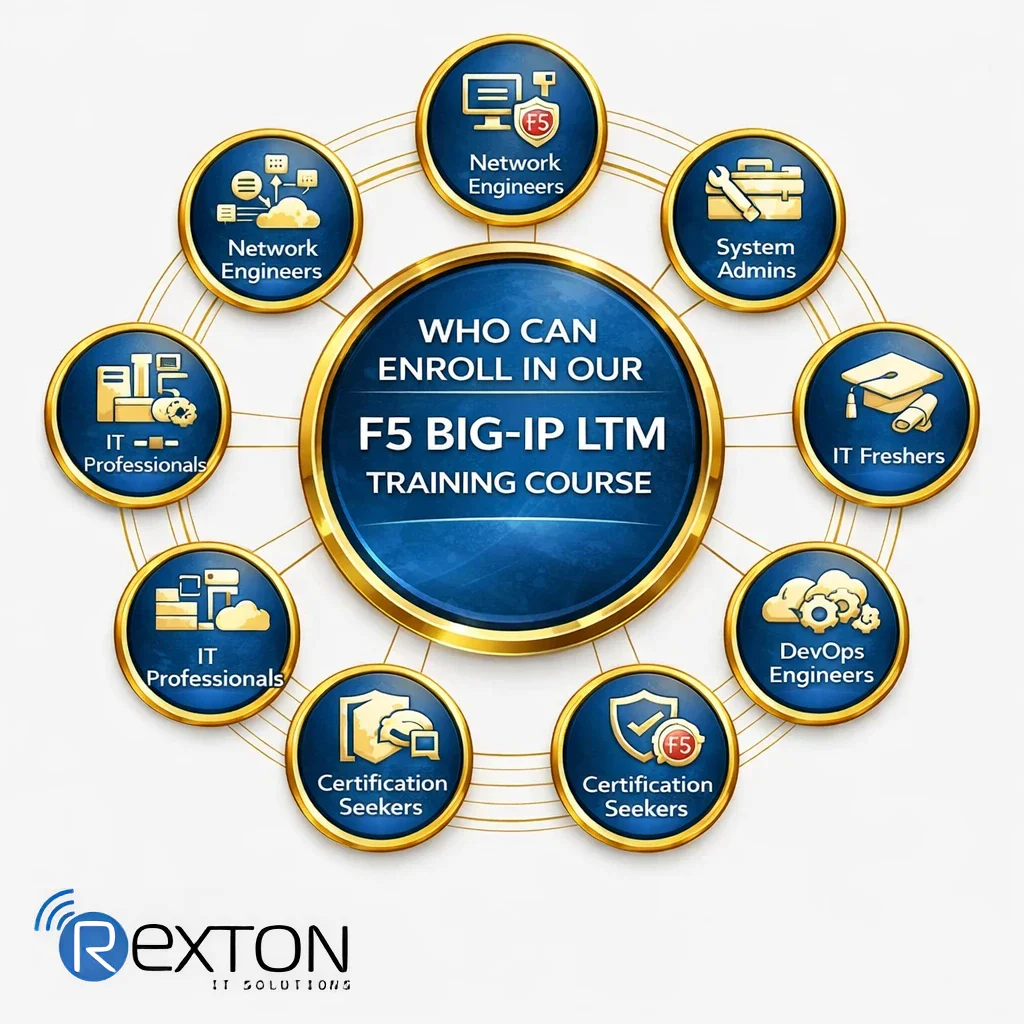
Who Can Enroll in our F5 BIG IP LTM Training Course?
- Network engineers who want to improve their knowledge about load balancing and traffic management in an enterprise environment.
- System administrators who work with F5 BIG-IP LTM in real-time to efficiently manage day-to-day activities.
- IT freshers seeking foundational knowledge in networking and application delivery technologies.
- DevOps engineers who want to design scalable, secure, and highly available application environments.
- Individuals who want to get hands-on experience while preparing for the F5 certification.
Getting Started
This course is designed to help you build practical knowledge and develop industry-relevant skills through a structured learning path.
You'll gain access to:
- Comprehensive learning modules
- Practical exercises and real-world examples
- Downloadable resources and reference materials
- Assessments to evaluate your progress
Whether you're a beginner or looking to enhance your expertise, this course provides everything you need to learn at your own pace and achieve your goals.

What Do You Need to Know Before Enrolling in the F5 BIG IP LTM Course
It is significant to understand a few essential things when planning to enroll in the F5 BIG IP LTM course. However, this course covers load balancing, application security, and traffic management. Likewise, if you have a networking or IT infrastructure background, the course basics are a little easier to understand. Whether you are a beginner or a working professional, here are some key things that you need to know before enrolling in this program.
- Every candidate must have a basic understanding of Networking concepts, including TCP/IP, routing, and switching.
- Having a clear brief of practical exposure is important because F5 BIG IP LTM is used in enterprise environments.
- The course covers virtual labs and scenarios that develop hands-on skills.
- Regular practice of configuration commands, along with theory, is essential for the certification exam.
- You should also be aware that the course is not entirely theoretical. Thus, it includes many labs and configurations. You will be required to work with both the CLI and the GUI.
- Finally, if you plan to become F5-certified, it is important to practice regularly and review the syllabus. With proper preparation, this course can help advance your career in networking.
- Module 1: Introduction to F5 BIG-IP and LTM Overview – Application delivery fundamentals, What is F5 BIG-IP, Role of LTM in application delivery, Benefits of ADC (Application Delivery Controller), Hardware vs. Virtual Editions (VE), BIG-IP system architecture, Traffic flow basics.
- Module 2: BIG-IP LTM Architecture and Core Concepts – Client-side vs. Server-side architecture, Full Proxy architecture, OneConnect, TMOS (Traffic Management Operating System), Control plane vs. Data plane, CMP (Clustered Multiprocessing), TMM (Traffic Management Microkernel).
- Module 3: Initial Setup and BIG-IP System Configuration – Licensing types and activation, Provisioning LTM module, Initial setup utility, VLANs and Self IPs, Interfaces and trunks, Route domains, Default gateway and routing table, NTP, DNS, and system settings.
- Module 4: Nodes, Pools, and Pool Members – Understanding Nodes vs. Pool Members, Creating and managing Nodes, Pools, and Pool Members, Priority group activation, Ratio and connection limits, Slow ramp time, Pool member states, and troubleshooting.
- Module 5: Load Balancing Methods and Persistence – Static vs. Dynamic load balancing methods (Round Robin, Least Connections, Ratio, Fastest, Observed), Persistence concepts and use cases, Source Address Affinity, Cookie persistence, SSL persistence, Universal persistence profiles.
- Module 6: Health Monitoring and Failover Logic – Purpose of health monitors, Default vs. custom monitors, Layer 4 vs. Layer 7 monitors, HTTP, HTTPS, TCP, ICMP monitors, Timeout and interval tuning, Troubleshooting monitor failures.
- Module 7: Virtual Servers and Traffic Handling – Types of Virtual Servers (Standard, Forwarding, Performance (L4), Reject), Destination Address and Port translation, SNAT and SNAT pools, Automap vs. SNAT pools, Traffic flow troubleshooting.
- Module 8: Profiles and Application Optimization – Profile types and hierarchy, TCP profiles (client-side vs. server-side), HTTP profiles, OneConnect profiles, SSL profiles overview, Performance tuning and optimization best practices.
- Module 9: SSL Offloading and SSL Profiles – SSL termination concepts, Client-side vs. Server-side SSL, SSL certificates and keys, Certificate chains and trust, Creating and applying SSL profiles, Common SSL issues and troubleshooting.
- Module 10: High Availability and Redundancy (HA) – Device Service Clustering (DSC), Active/Standby vs. Active/Active, Traffic groups, ConfigSync, Failover triggers, HA best practices, Split-brain scenarios and recovery.
- Module 11: Security Features in LTM – LTM security capabilities overview, DoS protection basics, Rate limiting, iRules for security use cases, Source address filtering, LTM vs. AFM overview, Securing applications with LTM.
- Module 12: iRules Fundamentals – Introduction to iRules and TCL basics, iRules events (CLIENT_ACCEPTED, HTTP_REQUEST, SERVER_CONNECTED), Common iRules use cases, Traffic steering, Header manipulation, Redirects, Logging and debugging iRules.
- Module 13: Logging, Monitoring, and Troubleshooting – BIG-IP logging framework, LTM logs and error messages, Statistics and dashboards, tcpdump and ssldump, Packet tracing, Common LTM issues and resolution workflow.
- Module 14: BIG-IP Management and Maintenance – User roles and permissions, UCS backups and restores, Software upgrades and hotfixes, Licensing changes, Configuration archives, Best practices for production environments.
- Module 15: Advanced LTM Features – Route domains and multi-tenancy, IPv6 support, Connection mirroring, Advanced persistence scenarios, LTM with DNS (GTM overview), Integration with security and cloud platforms.
- Configuration & Troubleshooting
- Interview Preparation
- Exam Preparation (F5-CA / 201-Level – TMOS Administration)
Book A Demo Class
Benefits of Our Comprehensive F5 BIG IP LTM Training and Course


Expert-Trained Faculty

Innovative Learning Methodology

Be Future-Ready with AI
High-Paying Role after F5 BIG IP LTM Training and Course
| Role / Job Title | Typical Experience | Salary (India) | Salary (Global / USD) |
|---|---|---|---|
| F5 Network Engineer / BIG-IP Admin | Entry to Mid (0–3 yrs) | ₹5 L – ₹10 L / year | $60,000 – $90,000 / yr |
| F5 Administrator / Load Balancer Admin | Mid (2–5 yrs) | ₹8 L – ₹15 L / year | $70,000 – $100,000 / yr |
| F5 Network Security Engineer | Mid–Senior (3–7 yrs) | ₹12 L – ₹20 L / year | $85,000 – $120,000 / yr |
| F5 DevOps / Cloud Network Engineer | Mid–Senior (3–7 yrs) | ₹15 L – ₹22 L / year | $90,000 – $130,000 / yr |
| Senior F5 Engineer / Consultant | Senior (5–10 yrs) | ₹20 L – ₹30 L / year | $110,000 – $150,000+ / yr |
| F5 Solution Architect / LTM Expert | Expert (10+ yrs) | ₹30 L – ₹50 L / year | $130,000 – $160,000+ / yr |
| F5 Application Security Engineer (WAF/ASM) | Mid–Senior (3–8 yrs) | ₹15 L – ₹25 L / year* | $90,000 – $135,000 / yr |
| Technical Lead / Traffic Management Lead | Senior (8+ yrs) | ₹30 L – ₹50 L / year* | $130,000 – $160,000+ / yr |

Our Recently Placed Students





Frequently Asked Questions
Yes, the F5 certification is worthwhile. It improves job prospects and proves expertise in advanced networking. Companies hire F5-certified individuals and pay them higher wages. F5 engineers receive between $90,000 and $140,000 per year, depending on their experience and position.
The LTM is widely known for its application health and performance-based load-balancing functionality, but it offers much more.
F5 training ranges from basic to advanced, depending on their knowledge and experience. Furthermore, these ranges begin with the foundational principles of F5 Networks and culminate in a maestro of F5 Technologies and Solutions.
Whereas traditional load balancers are merely traffic distributors, F5 is an application-layer solution that understands application behavior, secures applications, optimizes application performance, and supports cloud and DevOps ecosystems, making it a complete application delivery and security solution.
Here are some job roles that you can easily pursue after receiving your F5 Certification:
- F5 Network Engineer / BIG-IP Admin
- F5 Administrator
- Senior F5 Engineer
- F5 Application Security Engineer (WAF/ASM)
- Technical Lead / Traffic Management Lead
