
Palo Alto Networks Certified Network Security Administrator – PCNSA Certification Course
This PCNSA course is ideal for beginners and experienced computer network security professionals alike, whether aiming for high-paying jobs or a Palo Alto certification. With Rexton IT Solutions, you will not only learn the key concepts but also get hands-on experience with implementing, designing, and maintaining advanced cybersecurity solutions. The aim of our Palo Alto Networks Certified Network Security Administrator course is to get you job-ready and help you build a strong resume.
Enroll Now

Book A Demo Class
Why is This PCNSA Course Different?
Our PCNSA course takes a practical approach and primarily focuses on developing in-demand skills to get you ahead of the competition. Moreover, we take a structured approach to ensure you first develop strong fundamentals before proceeding to complex network security concepts. More highlights of this course include:
- Multiple Job Opportunities – Grow your career in the right direction with frequent placement drives
- Flexible Learning – Self-paced learning with online and offline classes
- Doubt-clearing Sessions – Attend personalized sessions with industry experts to answer all your doubts and queries
- Interview Preparations – Mock interviews with the latest and most relevant questions for complete technical interviews training
- Complete Revision Support – You can access the course materials anytime for revision
- Practical Training – Get hands-on experience with relevant software tools and applications
Training Features

1-on-1 Training
Clear All Your Doubts

Flexible Learning
Online and Offline Classes for Self-paced Learning

Mock Interviews
Complete Preparation for Technical Interview Rounds

Placement Support
Start and Grow Your Career with Us
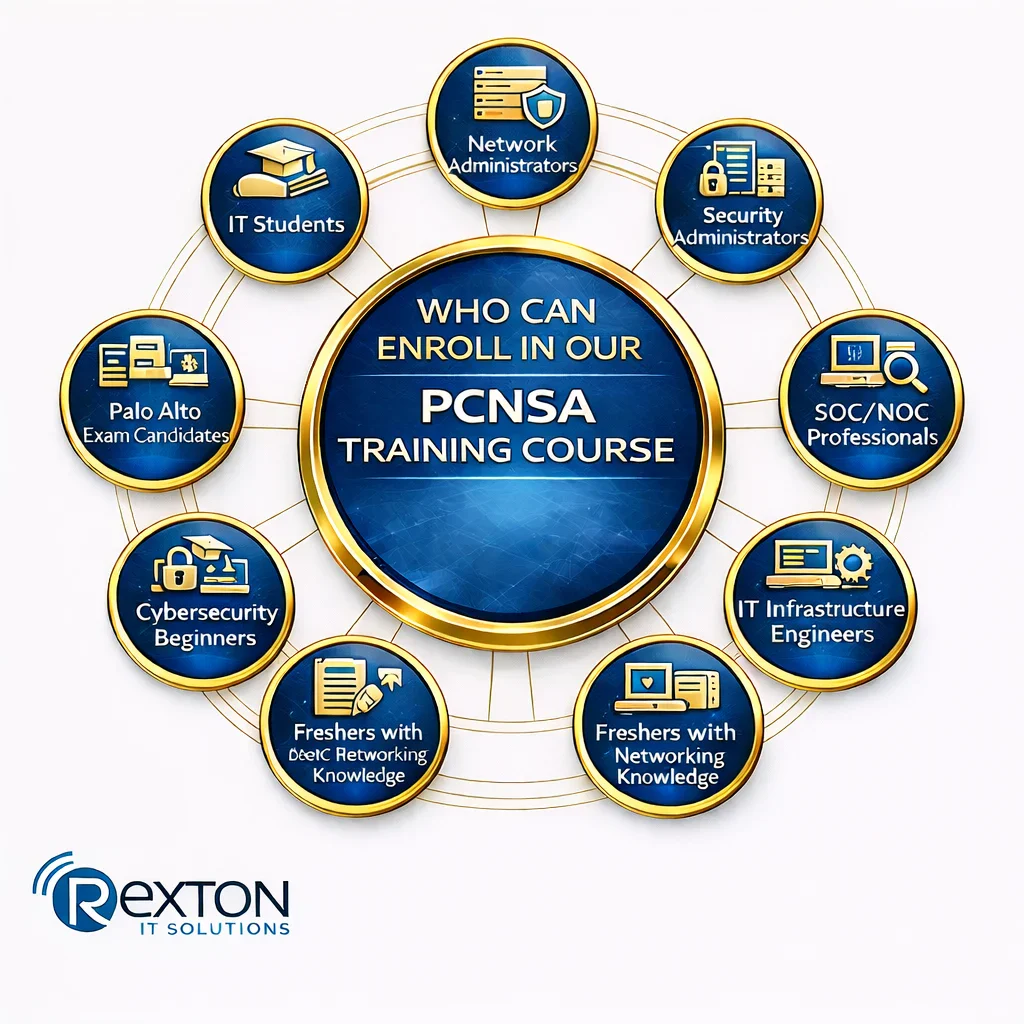
Who Can Enroll in our PCNSA Training Course
The PCNSA training course by Rexton IT Solutions covers an introduction to Palo Alto architecture and its fundamentals. Therefore, even complete beginners can take this course and grow their career in network security. Let’s see who can and who should enroll in this:
- Network administrators managing enterprise networks and traffic
- Security administrators responsible for enforcing security policies
- Firewall administrators working with next-generation firewalls
- SOC / NOC professionals monitoring threats and network performance
- IT infrastructure engineers supporting secure network environments
- Cybersecurity beginners starting a career in network security
- Freshers with basic networking knowledge seeking industry-ready skills
- IT students pursuing careers in networking or cybersecurity
- Candidates preparing for the Palo Alto certification exam
Still confused whether taking the PCNSA course is the right choice? Contact our experts for comprehensive career counselling.
Getting Started
This course is designed to help you build practical knowledge and develop industry-relevant skills through a structured learning path.
You’ll gain access to:
- Comprehensive learning modules
- Practical exercises and real-world examples
- Downloadable resources and reference materials
- Assessments to evaluate your progress
Whether you’re a beginner or looking to enhance your expertise, this course provides everything you need to learn at your own pace and achieve your goals.

What Do You Need to Know Before Enrolling in the PCNSA Course
While there are no formal or strict requirements for the PCNSA course, having the following prerequisites can significantly improve your learning curve:
- No mandatory prerequisites
- Basic networking fundamentals
- TCP/IP and subnetting knowledge
- Understanding of routing concepts
- Firewall basics awareness
- Security policy concepts
- NAT and zone familiarity
- General cybersecurity basics
- Hands-on firewall exposure (recommended)
- Palo Alto firewall basics (preferred)
- Lab or practice access (optional)
- Willingness to learn security operations
- Introduction to Palo Alto Networks Architecture – Overview of NGFW features and components, PAN-OS platform architecture, Control plane vs. data plane functions, Licensing and subscriptions overview.
- Initial Configuration – Web interface and CLI introduction, Initial setup (interfaces, zones, DNS, NTP, etc.), Admin account management, Configuration backup and restore.
- Interface Configuration – Physical vs. logical interfaces; Layer 2 and Layer 3 interfaces; Virtual Wire and Tunnel interfaces; VLAN and subinterface configuration; Security zones and virtual routers.
- Security and NAT Policies – Security policy fundamentals, Rulebase construction and best practices, Policy match and rule evaluation logic, NAT configuration: static, dynamic, and port address translation, Policy optimization.
- App-ID – What is App-ID and why it’s used, Application signatures and categories, Controlling applications by function, Decryption policies (SSL/TLS), Application filters and groups.
- Content-ID – Antivirus, Anti-Spyware, and Vulnerability Protection; File blocking profiles; URL filtering categories and actions; Data filtering and WildFire integration; Log generation for blocked threats.
- User-ID – Mapping users to IP addresses, User-ID agents, and integration with AD, User-ID redistribution, Policy enforcement based on user identity.
- Decryption – Why decryption is important, SSL inbound vs. outbound inspection, Decryption policy rules, Certificates and certificate management, Troubleshooting SSL issues.
- Site-to-Site VPNs and GlobalProtect – IPsec VPN configuration, IKE gateways, tunnels, and proxy IDs, GlobalProtect portal and gateway setup, Agent installation and connection flow, Authentication and HIP profiles,
- High Availability – Active/Passive HA setup, HA states and synchronization, Failover triggers and link monitoring, Configuration and troubleshooting.
- Monitoring and Reporting – Log types and log filtering, Custom reports and scheduled reports, Application Command Center (ACC), Dashboard and widgets, Log forwarding to external systems (Syslog/SIEM).
- Troubleshooting – CLI troubleshooting commands, Packet capture and flow logic, Session browser, Configuration audit and rollback, Troubleshooting tips by feature (VPN, NAT, Policy, etc.).
- Interview Preparation
- Exam Preparation
Book A Demo Class
Benefits of Our Comprehensive PCNSA Training and Course


Learn from Experienced Faculty

Creative Environment

AI-based Training
High-Paying Role after PCNSA Training and Course
| Job Role | Key Responsibility | Estimated Salary (INR / Year) |
|---|---|---|
| Firewall Administrator | Manage firewall rules and policies | ₹3 L – ₹6 L |
| Network Security Engineer | Secure and maintain network infrastructure | ₹4 L – ₹10 L |
| SOC Analyst / Security Analyst | Monitor threats and incidents | ₹3 L – ₹8 L |
| Network Administrator (Security) | Handle network operations with a security focus | ₹4 L – ₹8 L |
| Cybersecurity Analyst | Analyze and respond to security risks | ₹4 L – ₹10 L |
| IT Security Consultant (Junior) | Assist with security assessments and deployments | ₹6 L – ₹12 L |
| Security Operations Engineer | Manage day-to-day security operations | ₹5 L – ₹12 L |
| Incident Response Analyst | Investigate and respond to security breaches | ₹4 L – ₹12 L |
| Cloud Security Engineer* | Secure cloud networks and workloads | ₹6 L – ₹15 L |
| Information Security Specialist | Implement policies and compliance controls | ₹5 L – ₹15 L |
The salaries mentioned above are rough estimates gathered from multiple job-listing websites. The actual figures may differ depending on the organization’s size and its pay scale.

Our Recently Placed Students





Frequently Asked Questions
This course will help you develop the following practical skills:
Firewall deployment & setup
Security policy configuration
Traffic inspection & control
NAT rule implementation
Security rule troubleshooting
Device & network management
Configuration backup & restore, and more.
The PCNSA course by Rexton IT Solutions is completely self-paced. Thus, you can take the lectures at your convenience and choose a batch timing that suits your job schedule.
No, you do not need PCNSA certification to apply for a job as long as you can prove your skills. But having the Palo Alto certification is highly beneficial and boosts your resume’s visibility.
PCNSA certification exam details:
- Multiple-choice questions
- ~60 questions total
- 90 minutes duration
- Online or test center option
